Organizing the first SportsHCI conference in 2025

I am thrilled to announce that I am serving as the General Chair of the inaugural SportsHCI 2025 conference, alongside my colleague Michael Jones from Brigham Young University (USA) and a wonderful team of sportsHCI enthusiasts! This exciting new conference, dedicated to Human-Computer Interaction (HCI) in sports and physical activity, will take place at the University of Twente in the Netherlands in 2025. We aim to bring together researchers, designers, practitioners, and enthusiasts to explore the dynamic intersection of technology and sports.

As sports evolve in the digital age, technology plays an increasingly pivotal role. From wearable devices tracking performance to virtual training environments and AI-driven coaching tools, the possibilities are vast and inspiring. SportsHCI will be the premier platform to share advancements, exchange ideas, and shape the future of sports interaction. SportsHCI is not just a showcase for technology—it’s a platform for addressing real-world challenges and fostering meaningful innovations that enhance human experiences in sports.

Over the years, I have gained substantial experience in SportsHCI research, initiated through the work conducted by my PhD candidates and Master’s students at TU Eindhoven, as well as during my time as a Vitality Squad Leader at TU/e. In 2023, we organized the SportsHCI Dagstuhl Seminar (see my past blog post) and the conference is one of the many follow-up activities from this 5-day workshop in Germany.

We are now inviting submissions for our Call for Papers. The conference welcomes a wide range of contributions, including empirical studies, reviews, theoretical frameworks, methodological advances, case studies, and innovative systems. Papers addressing real-world challenges or proposing novel solutions will be especially valued. Whether you have a groundbreaking study, a novel design approach, or a unique case study, we would love to hear from you.

The full Call for Papers is now available on our website at SportsHCI.com, with detailed themes, submission guidelines, and key dates. For those interested in showcasing their work, we also have a dedicated track for demos of innovative systems and artifacts that push the boundaries of sports interaction. This is your opportunity to inspire and be inspired by the creativity and ingenuity of the SportsHCI community.

Follow us on social media (BlueSky @sportshci.bsky.social) for the latest updates and insights. Stay tuned for updates on our website and social media channels as we gear up for this unforgettable event. Together, let’s shape the future of SportsHCI and create technologies that empower athletes, coaches, and enthusiasts around the globe.

Mark your calendars, spread the word, and prepare to contribute to this exciting new chapter in HCI research. We can’t wait to welcome you to the Netherlands in 2025!
Empathy in Design Scale (EMPA-D)

Measuring Empathy in Design: A New Scale to Enhance Service Experiences

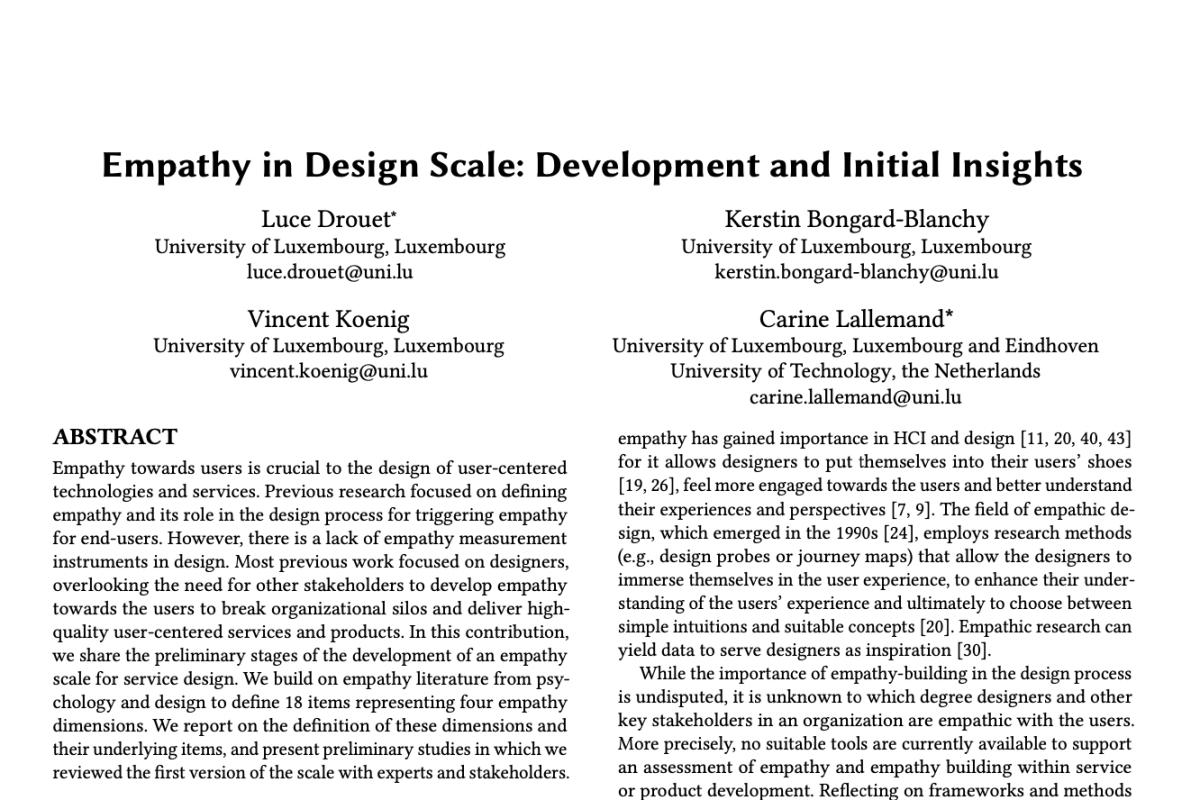
Empathy is at the heart of user-centered design, but how do we measure it effectively in a service design context? Our latest research introduces the Empathy in Design Scale (EMPA-D), a novel tool crafted to measure employees’ empathy toward service users. This validated scale bridges a critical gap in the design field, enabling organizations to assess and foster empathy systematically.

Collaborating with my former Ph.D. candidate Luce Drouet, we undertook this project as part of an exciting collaboration on service design with Luxembourg’s public railway company CFL. Together, we explored a variety of empathic methods, driven by a shared commitment to elevate user-centered practices and the UX maturity of the organization. The scale’s development reflects our deep interest in translating empathy into measurable, actionable insights for service organizations.

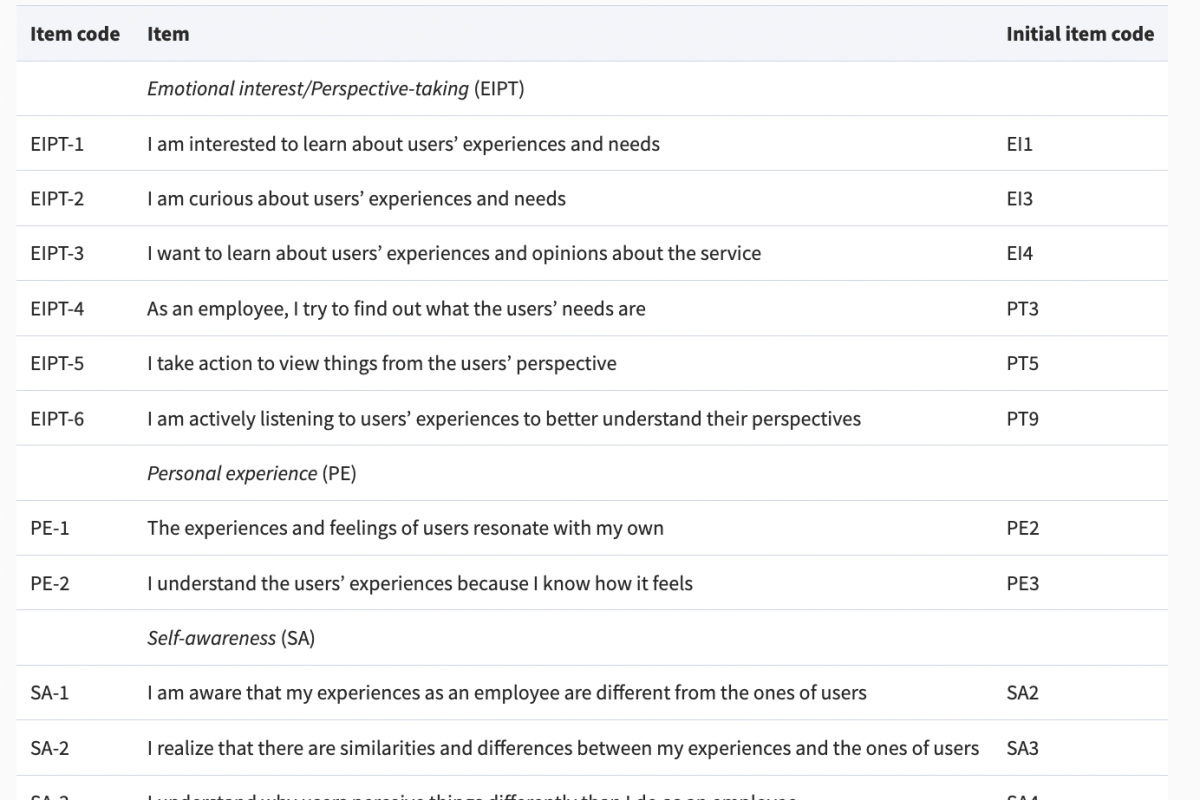
The EMPA-D scale was built following best practices in scale development. As part of this process, we conducted two quantitative studies, involving over 700 service employees from various industries. With a three-factor structure—Emotional interest/Perspective-taking, Personal experience, and Self-awareness—this 11-item tool provides robust psychometric properties. It offers a practical means for organizations to evaluate and enhance employees’ empathy, aligning their mindset with user-centered service goals. This work underscores empathy’s central role in shaping meaningful interactions and improving service experiences.

The 11-item Empathy in Design Scale (EMPA-D)

Explore the full article (open access). To delve deeper, explore our other publications on empathic methods in design.
What role could empathy play in transforming your design practice or organization? Let us know how you plan to use these insights!


How to cite our paper:
Luce Drouet, Kerstin Bongard-Blanchy, Carine Lallemand*, Development of the Empathy in Design Scale: Measuring Employees’ Empathy Toward Users in Service Design, Interacting with Computers, 2024, iwae019, https://doi.org/10.1093/iwc/iwae019

Dagstuhl Seminar 23292 on SportsHCI

In July 2023, I co-organized the Dagstuhl Seminar on SportsHCI, with Florian ‘Floyd’ Mueller, Dennis Reidsma, and Elise van den Hoven. It was an amazing week, which led to several outcomes to date. The official report of our Seminar has just been released in the proceedings of Dagstuhl (open access).

What is a Dagstuhl Seminar?

If you are a scientist in #CS or #HCI, you probably have heard of Dagstuhl seminars at some point. The mission of Schloss Dagstuhl – Leibniz Center for Informatics is to “further world-class research in CS by facilitating communication and interaction between researchers”. It is done through their famous seminars at the castle, open-access publishing and the dblp database. The castle is located in a small village in Germany named Wadern, close to the borders with France and Luxembourg. Seminars bring together 20-35 researchers and practitioners from all around the world for an intensive week of work on a dedicated topic. Attendees are selected by the organizers and can only attend by invitation. To know more about Dagstuhl seminars, check my post.

Seminar 23292 on SportsHCI

Interactive systems are increasingly used to support sports and physical exercise activities, not only for functional purposes, such as sensing achievements to determine personal records, but also for experiential reasons, such as highlighting the joy of movement, aiming to enrich the sports experience. The result is a surge in human-computer interaction systems for sports, such as sports watches that not only optimize runner’s athletic training plans but also provide beat-adjusted music for entertainment, augmented reality systems in stadiums to support the audience experience, and AI-enhanced capture systems to allow remote parents watch their kids play soccer from afar. We call the resulting field “SportsHCI”.

A growing body of sensors, devices, and systems support these SportsHCI applications, allowing people to engage with athletic performance in novel and interesting ways, extending the field of HCI beyond the mouse and keyboard paradigm. Unfortunately, what is missing, though, is a thorough understanding of how to design such SportsHCI systems in a systematic way. This is in part due to a lack of a theoretical framework that is concerned with the coming together of computing and the physically active human body in a way that incorporates and integrates all aspects of movement, performance, learning, and experience, and a lack of understanding of how this combination has implications for how we approach the design of SportsHCI. It seems reasonable to assume that efforts that aim to address this could help people to engage more in physical activity, and maybe even reach previously unengaged people, motivating them to try physical activity, so that ultimately, more people profit from the many physical, social and mental health benefits sport and exercise activity can provide.

This Dagstuhl Seminar builds on prior work that highlighted that supporting sport and exercise activities with technology should not only be concerned with functional aspects, such as measuring and comparing athletic performance, but also consider the experiential aspects, in other words, how sports people feel about their athletic performance. Therefore, the seminar brings together researchers and industry members who understand that successful sport and exercise activity-support technology needs to be designed with also this experiential perspective in mind, and seek to develop guidance on how to support it. This seminar invites experts from both industry and academia, including experts from sports science as well as HCI and design experts, to work towards identifying the grand challenges in SportsHCI so that a coherent approach can be developed in order to help more people profit from the benefits of sports and physical exercise.

Sentence completion: a lightweight user research technique

My favourite UX research method is…’ — This is an example of a sentence stem, the type of stimulus used in the sentence completion technique. Respondents are provided with the beginnings of sentences that they complete in ways that are meaningful to them. It is based on the principle of ‘fill in the blanks’. Transferred to HCI from the field of psychology, SCT is a promising user research technique. One of the main interests of the method lies in its ability to collect rich qualitative data remotely and in a cost-effective way.

In the past years, I have conducted several studies on the Sentence Completion Technique (SCT), to understand how to optimize these sentence stems for qualitative (e.g., during a focus group, workshop, or interview) or quantitative studies (for instance, within an online survey).

The SCT has its roots in psychology, where this semi-structured projective technique is popular in several application areas, such as intelligence tests (introduced by Ebbinghaus, 1897) or psychological assessment. In user research, the method is not used as a projective tool, but rather serves to elicit information without leading the participants, and as an alternative format to collect qualitative insights within surveys. The SCT gives participants some structure by providing the beginning of a sentence (i.e. a sentence stem), but allows participants to freely formulate their response, using their own words to complete the sentence. Amongst other benefits, participants thus have greater autonomy on their answers as compared to the widely used Likert-scale items, where they can only voice their agreement or disagreement with a statement or compared to multiple-choice questions presenting a limited, pre-defined list of choices. The nature of SCT can be helpful, as it guides the participant on the insight that the researcher is looking for without introducing prominent response biases. It is also usable on populations who may face difficulties with open-ended questions and provides a degree of standardization that facilitates data collection and analysis.

I have co-authored two key articles on the SCT, including examples and recommendations on the best use of the method:

  • Denise Schmidt, Karsten Nebe, Carine Lallemand, Sentence Completion as a User Experience Research Method: Recommendations From an Experimental Study, Interacting with Computers, 2024, iwae002, https://doi.org/10.1093/iwc/iwae002
  • Carine Lallemand and Emeline Mercier. 2022. Optimizing the Use of the Sentence Completion Survey Technique in User Research: A Case Study on the Experience of E-Reading. In Proceedings of the 2022 CHI Conference on Human Factors in Computing Systems (CHI ’22). Association for Computing Machinery, New York, NY, USA, Article 319, 1–18. https://doi.org/10.1145/3491102.3517718

You can also watch the video of my presentation of the paper during the British Computer Science HCI/UX seminar by the Editor-in-Chief of the Interacting with Computers journal, Prof. Helen Petrie.

Echelle Empathy in Design (EMPA-D)

Dernière née des échelles de mesure développées par notre groupe de recherche HCI à Luxembourg, notre échelle Empathy in Design Scale (Empa-D) permet d’évaluer le niveau d’empathie de parties prenantes d’une entreprise (typiquement les employés d’un service) envers les utilisateurs finaux. Elle reflète en partie le niveau de maturité UX d’une entreprise, et peut aider à le développer en ciblant des aspects particuliers.

C’est à la thèse de ma doctorante Luce Drouet que nous devons cet instrument. Luce travaille sur les méthodes empathiques dans le design de service, et tente, à travers de nombreuses interventions, de comprendre comment développer de l’empathie chez les employés d’un service envers les utilisateurs. Pour comprendre si une intervention est bénéfique, faut-il encore être capable de mesurer le niveau de base de l’empathie au sein d’une entreprise, puis voir son évolution après des interventions visant à développer la maturité UX d’une organisation.

Une publication initiale a été présentée lors de la conférence CHI 2022 (attention, les items de l’échelle finale sont désormais un peu différents !): https://doi.org/10.1145/3491101.3519848

L’échelle finale, après 2 études de validation complète, comprend 11 items divisés en 3 sous-dimensions (pour le moment en anglais uniquement, mais la version FR est en phase de test et sera bientôt disponible également): Emotional Interest/Perspective Taking (EIPT), Personal Experience (PE), Self-Awareness (SA).

References:
Luce Drouet, Kerstin Bongard-Blanchy, Vincent Koenig, and Carine Lallemand. 2022. Empathy in Design Scale: Development and Initial Insights. In Extended Abstracts of the 2022 CHI Conference on Human Factors in Computing Systems (CHI EA ’22). Association for Computing Machinery, New York, NY, USA, Article 373, 1–7. https://doi.org/10.1145/3491101.3519848

Office Agents

Imaginez l’environnement de travail du futur… Vous entrez dans votre “smart building”, bâtiment bardé de capteurs capable de mesurer la qualité de l’environnement de travail et d’optimiser l’énergie utilisée. A votre poignet, un bracelet connecté mesure votre activité physique. Dans votre smartphone se trouvent une myriade d’apps permettant de mesurer ou d’analyser vos comportements ou votre santé. L’une d’entre elle mesure même votre productivité et vous aide à lutter contre la procrastination. Tout cela fait peut être déjà partie de votre quotidien, ou ne semble pas si éloigné de la réalité… mais est-ce un futur désirable ?

De cette réflexion est né un project de recherche par le design, mené par mon étudiant Sjoerd Stamhuis à l’Université d’Eindhoven. Et si chaque employé était équipé d’un kit de capteurs capable de mesurer son niveau d’activité physique, sa productivité ainsi que la qualité de l’environnement de travail, et d’indiquer quand l’un de ces paramètres n’est pas optimal ?

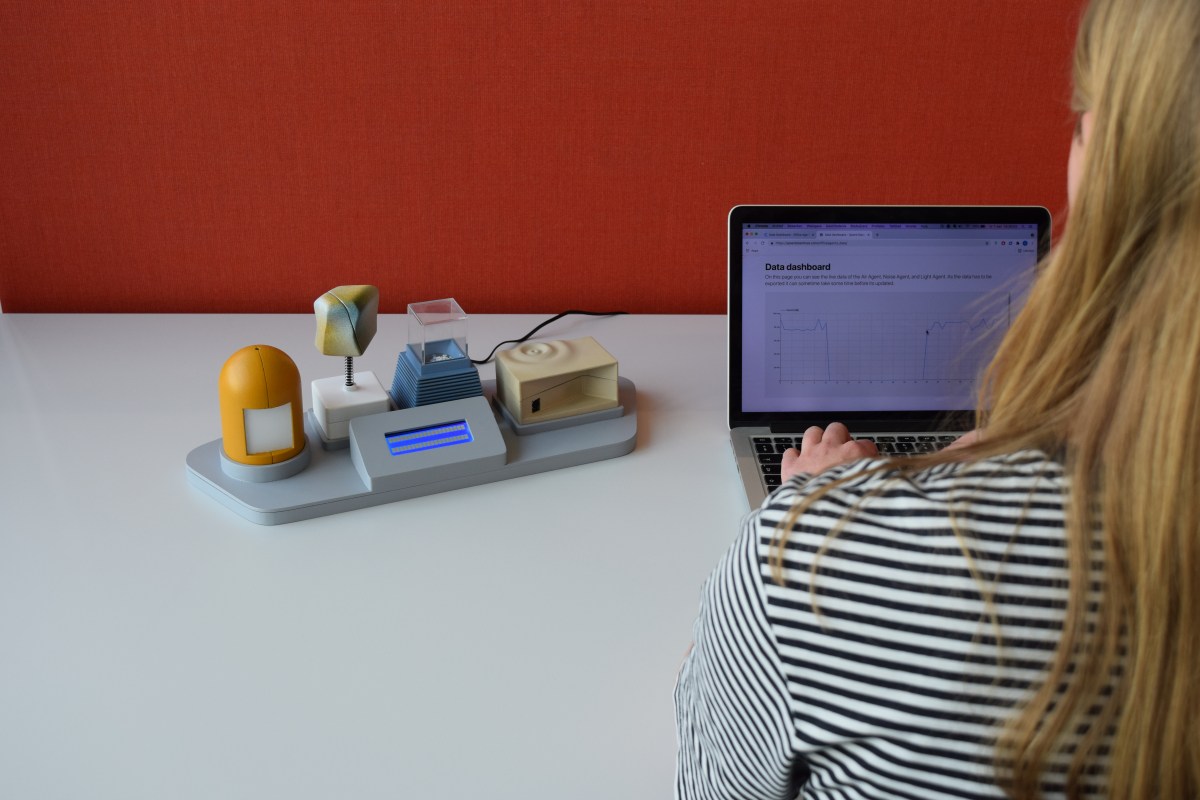
Les Office Agents sont un set de 5 capteurs placés sur chaque poste de travail. Dans un esprit de design spéculatif, chaque agent a une personnalité et la ferme intention de vous aider à optimiser votre travail pour être productif et en bonne santé.

  • L’agent de productivité tracke vos tâches et votre concentration et vous envoie des notifications écrites pour vous rappeler à l’ordre. Il est rigoureux et plutôt autoritaire.
  • L’agent d’activité physique est lié à votre montre connectée et combat la sédentarité au travail. Il vous stimule à bouger davantage quand il ne détecte pas de mouvement pendant 30 min. Pour se faire, il gigote pour attirer votre attention.
  • L’agent de l’air mesure constamment la qualité de l’air à l’aide d’un capteur intégré. Il active son ventilateur pour vous notifier qu’il est temps d’ouvrir la fenêtre pour aérer votre espace de travail.
  • L’agent du bruit capte les décibels autour de votre bureau. Il émet des vibrations répétées quand le niveau sonore dépasse 70 décibels pendant plusieurs secondes, c’est une invitation au silence !
  • L’agent de lumière mesure la luminosité à votre poste de travail à l’aide d’un capteur intégré. Quand elle est inférieure à 300 Lux, il clignote et indique que vous devriez trouver une place près d’une fenêtre ou augmenter la lumière artificielle.

Arriverez-vous à suivre les recommendations de vos agents ? Certaines de ces requêtes vont-elles se contredire ? (suivre le conseil de l’agent d’activité physique pour aller faire une marche ne va sûrement pas plaire à l’agent de productivité). Peut-on optimiser son environnement de travail en prenant en compte toutes les bonnes pratiques ? Quels sont les défis et les limites de cette approche du travail où tout est mesuré et optimisé ?

Sjoerd Stamhuis, Hans Brombacher, Steven Vos, Carine Lallemand. 2021. Office Agents: Personal Office Vitality Sensors with Intent. Proceedings of the Extended Abstracts of the 2021 CHI Conference on Human Factors in Computing Systems. https://dl.acm.org/doi/10.1145/3411763.3451559 (open access)

Regardez la video du projet (30 sec): https://youtu.be/AEEI5bZXNnA

The Hubs

Le Hub est une station de travail qui s’adapte à différentes tâches lors des walking meetings (réunions en marchant). Les Hubs forment un réseau qui guide les employés durant leur réunions : libres à eux de s’arrêter à un hub pour prendre des note ou consulter un document. Chaque hub est équipé de quatre écran tactiles et d’un scanner RFID permettant de se connecter, avec un simple badge, à un environnement web personnalisé. La forme des Hubs est inspirée des panneaux de signalisation néerlandais ANWB, qui sont couramment utilisés pour indiquer la direction aux Pays-Bas.

Nous présentons la conception et l’usage des Hubs dans deux publications :

Ida Damen, Anika Kok, Bas Vink, Hans Brombacher, Steven Vos, Carine Lallemand. 2020. The Hub: Facilitating Walking Meetings through a Network of Interactive Devices. Proceedings of the 2020 Designing Interactive Systems Conference, Eindhoven, the Netherlands. doi:10.1145/3393914.3395876 (open access)

Ida Damen, Steven Vos & Carine Lallemand. 2021. The Hubs: Design Insights for Walking Meeting Technology. 18th IFIP TC International Conference on Human-Computer Interaction INTERACT’21, Bari, Italy.

Workwalk

La sédentarité au travail est un challenge grandissant, entraînant des problèmes de santé chroniques multiples. Si de nombreuses interventions (non-technologiques) existent dans le domaine de la santé au travail, il y a peu de produits interactifs qui encouragent les employés à adopter des modes de travail plus actifs. La plupart des systèmes existants fonctionnent sur base de notifications pour stimuler des pauses plus fréquentes.

Avec mon équipe, notamment ma collègue Ida Damen ainsi que mes étudiants du Vitality Squad, nous travaillons sur la conception de produits et services stimulant des modes de travail actifs. Parmi eux, les walking meetings (ou réunions en marchant).

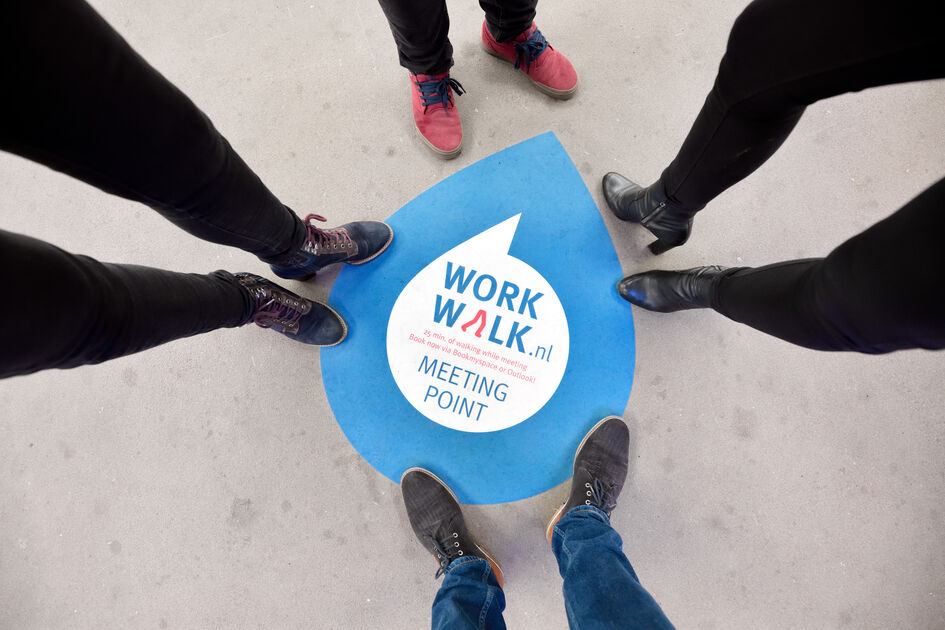
Le Workwalk est un concept de walking meeting installé sur le campus de TU Eindhoven depuis 2018 en tant que concept test. Il se présente sous la forme de lignes pointillées peintes au sol, formant un réseau de chemins propices à la pratique des réunions en marchant. Chaque route a une durée d’environ 25 minutes. Les employées peuvent réserver le Workwalk de la même façon qu’une salle de réunion, via le système de réservation de salles. Des points de rencontre sont situés à l’entrée des principaux bâtiments pour débuter la réunion.

Si la pratique des walking meetings est prometteuse, de nombreux challenges viennent en limiter l’usage à l’heure actuelle. Nous avons étudié les opportunités, obstacles et défis des walking meetings en réalisant des entretiens avec 16 utilisateurs du Workwalk à Eindhoven.

Retrouvez les résultats de cette étude dans l’article suivant:

Ida Damen, Carine Lallemand, Rens Brankaert, Aarnout Brombacher, Pieter van Wesemael, Steven Vos. (2020). Understanding Walking Meetings : Drivers and Barriers. Proceeding of the CHI Conference on Human Factors in Computing Systems. doi:10.1145/3313831.3376141

En complément de ce concept de service relativement low-tech, nous explorons des produits ou technologies pouvant soutenir la pratique des walkings meetings. Les Hubs en sont est un exemple.

Pour votre prochaine réunion, pourquoi ne pas tester la pratique du walking meeting ? Invitez 1-2 collègues à vous joindre durant une journée ensoleillée et découvrez une nouvelle façon de travailler, stimulante et créative !

UX Context Scale – Echelle d’évaluation quantitative des aspects contextuels

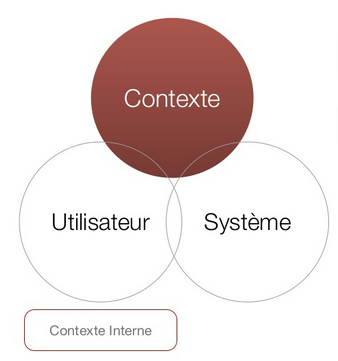
dimensions UXLes trois facteurs constitutifs de l’UX sont : le système, l’utilisateur et le contexte. Si de nombreux outils d’évaluation sont focalisés sur les qualités du système (ex. AttrakDiff) et l’état interne de l’utilisateur (ex. PrEmo ou échelle PANAS), peu d’outils existent pour évaluer le contexte d’utilisation. Parmi eux, les outils quantitatifs adaptés à l’UX sont à notre connaissance quasi-inexistants.

Généralement, dans la phase de recherche utilisateur, on va se renseigner sur le contexte d’usage afin de concevoir un produit adapté. Seulement, si l’on veut évaluer l’impact du contexte dans l’évaluation de la qualité de l’expérience, il faut trouver un outil adapté ! Dans ma thèse, j’ai développé une échelle d’évaluation de la qualité perçue du contexte. Celle-ci comprend à la fois les aspects objectifs et subjectifs du contexte.

Tout comme pour la traduction d’un outil d’évaluation (voir l’article sur la version française de l’AttrakDiff), la construction d’un outil quantitatif doit suivre une procédure rigoureuse pour garantir ses qualités psychométriques (sensibilité, fidélité, validité). Notre échelle de contexte a été créée en suivant cette procédure.

Vous pouvez utiliser l’échelle pour vos projets, elle est publiée en open access dans l’article suivant (qui doit être référencé lors de l’usage de l’échelle): 

Carine Lallemand & Vincent Koenig. 2020. Measuring the Contextual Dimension of User Experience: Development of the User Experience Context Scale (UXCS). NordiCHI ’20: Proceedings of the 11th Nordic Conference on Human-Computer Interaction. doi:10.1145/3419249.3420156